
Understand how customers discover, evaluate, choose and continue with a business—and how digital marketing can support them at each stage.
What Is the Customer Journey?
The customer journey is the series of experiences and decisions a person goes through as they move from recognising a need to evaluating possible solutions, choosing a business, experiencing what they receive, and deciding what happens next.
For a business, understanding this journey helps answer an important question:
What does a potential customer need from us at this point in their decision-making process?
That question is more useful than asking which marketing channel should be used first.
A person who has only just recognised a problem needs different information from someone comparing providers. Someone ready to make a decision needs different reassurance from an existing customer deciding whether to continue the relationship.
The journey therefore gives an SME a way to think about marketing from the customer’s perspective.
It is also important to recognise that the journey is not necessarily linear. Customers can move backwards, revisit earlier questions, enter at different stages, or move through several stages quickly. Research into consumer decision journeys has shown that real-world decision-making can be more irregular than a traditional funnel suggests.
Customer Persona: Understanding Who Your Customer Is
Before mapping a customer journey, an SME needs to understand who its target customer is. A customer persona provides a clear picture of the type of customer a business is trying to reach.
A persona may describe the customer’s role, business or personal circumstances, goals, challenges, priorities, buying concerns and the factors that influence their decisions. It helps a business look beyond broad descriptions such as “small businesses” or “working professionals” and develop a more useful understanding of the people it wants to serve.
A Simple Example
Consider a business that provides accounting services to small businesses.
Its target customer might be a small business owner who manages a growing company and is responsible for making financial decisions, but does not have an in-house finance team. This customer may value accuracy and compliance, but may also be concerned about cost, responsiveness, ease of communication and having reliable financial information when making business decisions.
These characteristics form part of the persona.
The persona does not describe how this customer moves through the buying process. Instead, it gives the business a clearer understanding of who the customer is and what matters to them.
Once that is understood, the business can map the customer’s journey: what causes the customer to recognise a need, what questions they ask, how they research possible solutions, what influences their decision, and what happens after they become a customer.
A customer persona describes the customer. The customer journey describes the customer’s experience as they move from need to decision and beyond.
Marketing Funnel vs Customer Journey
The terms marketing funnel and customer journey are often used interchangeably, but they provide different ways of looking at customer behaviour.
A marketing funnel is primarily a planning model. It helps a business think about how people may move from awareness towards a desired outcome.
A customer journey looks more closely at the customer’s experience. It considers what people are trying to understand, what questions they have, how they evaluate options, what influences their decisions, and what happens after the purchase.
The funnel can therefore help answer:
How should we structure our marketing?
The customer journey asks:
What is the customer experiencing and trying to accomplish?
The two approaches can work together. A funnel can help organise marketing activity, while a customer-journey view can help make sure that activity reflects what people actually need.
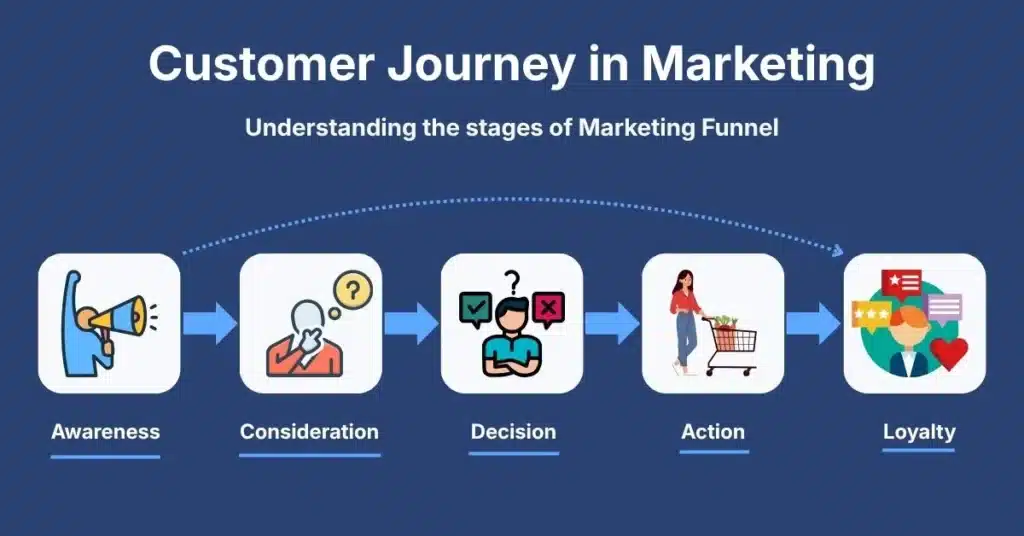
The broader marketing funnel is useful for planning movement from awareness towards purchase and ongoing relationships. The customer journey, however, becomes more complex when people can interact with a business through multiple digital channels, devices and sessions.
How Digital Marketing Changes the Customer Journey
Digital channels have made it easier for people to discover information, compare alternatives and return to a business at different points in their decision-making process.
A potential customer might:
- discover a problem through a search;
- read an educational article;
- view information from several providers;
- click a paid advertisement;
- visit a website;
- compare services;
- read reviews;
- return several days later;
- contact a business; and
- continue interacting after the purchase.
These interactions may happen across different devices, channels and sessions.
That makes the customer journey more complex for businesses, but it also creates more opportunities to provide useful information and build confidence.
Google Analytics provides tools such as funnel and path exploration specifically to help businesses understand the steps users take, identify drop-offs and examine the paths users follow through a website or app.
The implication for SMEs is important:
Digital marketing should not be planned as a collection of independent channels. It should help customers move through their decision-making process.
The Digital Marketing Customer Journey
For practical digital marketing planning, an SME can use five broad stages to understand the changing needs of customers:
Awareness → Consideration → Decision → Retention → Advocacy
These stages are a framework for understanding customer needs, not a rigid path that every customer must follow. Someone may enter at the consideration stage, move back to research, or become a repeat customer without repeating the entire journey.

At each stage, the business has a different job.
The objective is not to use every digital marketing service at every stage. It is to choose the activities that help customers make progress.
Stage 1: Awareness — Help People Understand the Problem
At the awareness stage, a person may recognise that something needs to change without yet knowing exactly what solution they need or which provider they should choose.
They may be asking:
What is the problem?
Why is it happening?
What options are available?
Do I need to act?
This is where education becomes valuable.
SEO
Search engine optimisation can help a business become visible when people search for information related to a problem, need or opportunity.
For example, someone may search for information about improving website visibility before they have decided that SEO services are the right solution.
Educational Content
Useful articles, guides, videos and resources can help people understand the issue without immediately asking them to buy.
Good awareness-stage content should answer the question the person is actually asking rather than turning every topic into a sales pitch.
PPC and Other Awareness Activity
Paid advertising can help a business reach relevant audiences when a useful opportunity exists to create awareness or introduce a solution.
The objective should be to reach people who are likely to find the message relevant rather than simply maximise impressions.
At this stage, the aim is to become visible and useful before asking the customer to make a decision.
Stage 2: Consideration — Help People Explore Their Options
At consideration, the customer has moved beyond simply understanding the problem.
They are beginning to ask:
What solutions are available?
Which approach is right for me?
Which businesses can provide it?
How do the alternatives compare?
This is where deeper information becomes important.
People may look at service pages, comparison content, case studies, reviews, demonstrations, specifications, FAQs and other forms of evidence.
Search Visibility
SEO can help a business appear for searches with stronger commercial relevance, including searches for particular services or solutions.
Content
Content can address common questions, explain approaches, compare options where appropriate, and demonstrate expertise.
Website Experience
The website needs to make it easy to understand what the business offers, who it serves and how its services differ from alternatives.
Reviews and Proof
Customer reviews, testimonials, case studies, qualifications and other relevant evidence can help people evaluate whether a business deserves further consideration.
At this stage, the goal is not necessarily to push the visitor towards an immediate enquiry. The goal is to give them enough useful information to compare their options with greater confidence.
Stage 3: Decision — Make It Easier to Choose
The decision stage is where a customer is moving towards selecting a provider or making a purchase.
The questions become more specific:
Can this business solve my problem?
Can I trust them?
What will working with them involve?
What happens if I get in touch?
What do I need to do next?
At this stage, clarity and ease of use can make a meaningful difference to customer confidence.
The website should make the proposition clear. Information should be easy to find. The next step should be obvious.
A business may also need to provide:
- clear service descriptions
- relevant proof
- appropriate pricing or scope information
- terms and expectations
- answers to common concerns
- straightforward contact options
Not every business needs to publish a fixed price. What matters is giving potential customers enough commercial clarity to understand what they are considering and what happens next.
Conversion Is Part of the Journey
A visitor reaching a website does not automatically become a lead. The page needs to give them the information, reassurance and next step needed to move forward.
Our Website Development Services are built around structure, user experience, content and business objectives so that a website can support the wider customer journey rather than simply present information.
Stage 4: Retention — Continue to Create Value After the Sale
The customer journey does not necessarily end when a transaction is completed.
After purchasing a product or engaging a service, customers form an opinion about the experience they received.
They may ask:
Did the business deliver what I expected?
Can I get help when I need it?
Was the experience worthwhile?
Would I choose this business again?
Retention therefore depends heavily on what the business actually delivers, but digital communication can support the relationship.
Useful activities can include:
- onboarding information
- helpful support content
- email communication
- product or service guidance
- feedback mechanisms
- updates relevant to existing customers
Google Analytics includes lifecycle reporting that helps businesses analyse user behaviour across stages such as acquisition and retention. This can help SMEs look beyond acquisition and examine what happens after someone first becomes a customer.
The important point is that retention is not simply another marketing campaign.
The customer experience itself is part of the journey.
Stage 5: Advocacy — Encourage Genuine Recommendations
A customer who has had a positive experience may be willing to recommend the business, leave a review, provide a testimonial, refer another customer, or share their experience in another way.
These actions can help future customers because recommendations and reviews provide information about the experience other people have had.
Businesses can support this stage by:
- asking customers for genuine feedback
- responding professionally to reviews
- making it easy for satisfied customers to recommend the business
- requesting testimonials where appropriate
- developing case studies with customer permission
The objective is not to manufacture advocacy.
It is to create an experience worth recommending and make it easy for customers to share it.
Not Every Customer Follows the Same Journey
One of the most important things for an SME to understand is that there is no single customer journey that applies to everyone.
The journey can change according to the:
- complexity of the purchase
- cost or perceived risk
- urgency of the need
- number of people involved in the decision
- customer’s existing knowledge
- relationship the customer already has with the business
Consider two examples.
Someone buying a simple consumer product may discover it, compare a few alternatives and purchase within minutes.
A business choosing a professional service may spend much longer researching providers, discussing requirements internally, comparing proposals and seeking reassurance before making a decision.
A repeat customer may bypass much of the awareness and consideration process because they already know the business.
This is why SMEs should map their own customer’s journey rather than simply copying a generic marketing model.
How Should an SME Map Its Customer Journey?
Customer-journey mapping does not need to become a complex enterprise exercise.
Start with the people you want to understand.
Identify the Customer
Who is involved in the decision?
For a small business, this may be the owner. In a larger organisation, there may be several people influencing the decision.
Identify the Need
What causes the person to begin looking for a solution?
Is it a problem, a change in circumstances, a new opportunity, or dissatisfaction with an existing solution?
Identify Their Questions
What does the customer need to understand at each stage?
These questions can reveal opportunities for content, website improvements and better communication.
Identify the Touchpoints
Where might the customer encounter the business?
This could include:
- Google Search
- Google Business Profile
- paid advertising
- social platforms
- blog content
- service pages
- reviews
- sales conversations
- customer support
Identify Friction
Where might the customer hesitate?
Perhaps important information is difficult to find. Perhaps the service is unclear. Perhaps the website does not answer an obvious concern.
Match Digital Activity to the Need
Once the journey is understood, decide which activities are useful at each stage.
Measure What Happens
Look at whether customers are progressing towards meaningful outcomes and where they are leaving the journey.
Google Analytics’ funnel and path exploration tools can help businesses analyse how users move through defined website or app experiences, identify drop-offs and investigate common paths before or after important actions.
Which Digital Marketing Strategy Should You Use at Each Stage?
There is no single digital marketing service that is automatically right for every stage.
The better question is:
What does the customer need at this point, and which activity can help provide it?
| Journey Stage | What the Customer Needs | Digital Activities That May Help |
|---|---|---|
| Awareness | Understand a problem, need or opportunity | SEO, educational content, selected PPC and awareness activity |
| Consideration | Research and compare options | SEO, service content, guides, reviews, website experience, PPC |
| Decision | Build confidence and take action | Website, conversion content, proof, clear contact options, targeted PPC |
| Retention | Receive value, support and reassurance | Customer communication, email, support content and useful resources |
| Advocacy | Share a positive experience | Reviews, testimonials, referrals and case studies |
These activities are not mutually exclusive. SEO and content can support several stages of the journey, while PPC can support different stages depending on the audience, campaign objective and search or browsing context.
The website can support many stages of the journey because customers may return to it repeatedly as they research, compare and decide. That is why digital marketing should be planned as a connected system rather than as a collection of isolated services.
SEO, PPC, Content and Website Development Do Different Jobs
Understanding the customer journey makes it easier to see why different digital marketing services have different roles.
SEO
SEO can help people discover a business when they search for information, products or services relevant to their needs.
Our SEO Services focus on strengthening search visibility around relevant customer needs and business objectives rather than treating rankings as the only measure of success.
PPC
PPC can help a business reach relevant audiences through paid advertising, including when people are actively searching for relevant products or services. It can support different stages of the customer journey, from creating visibility to generating targeted visits and enquiries. Its effectiveness, however, depends on how well the advertising, landing page, website, content and overall customer experience work together.
Content Development
Content helps customers understand problems, explore solutions, evaluate alternatives and make more informed decisions.
Our Content Development Services are designed around expertise, search intent, customer questions and the wider role content plays across the journey.
The website then brings these elements together. It provides the environment in which people discover information, evaluate the business, build confidence and decide whether to take action.
The point is not to use every channel simply because it exists. The point is to use the right combination of activities for the customer, the stage and the business objective.
Measuring the Customer Journey
Measuring the customer journey does not mean assigning a single number to every stage.
Different businesses need different measures.
Awareness
Possible measures include:
- relevant organic visibility
- content discovery
- qualified website traffic
Consideration
Useful indicators may include:
- service-page engagement
- repeat visits to relevant pages
- interaction with detailed content
- movement between relevant pages
Decision
The focus becomes:
- qualified enquiries
- consultations
- purchases
- calls or other meaningful conversion actions
Retention
Depending on the business, this might include:
- repeat purchases
- renewals
- continued engagement
- customer feedback
Advocacy
Possible measures include:
- genuine reviews
- referrals
- testimonials
- case-study participation
The goal is to understand whether the customer journey is helping the business achieve its objectives.
Common Customer Journey Mistakes
Treating Every Visitor as Ready to Buy
Someone discovering a problem may need education before they are ready for a sales conversation.
Sending Every Visitor to the Same Call to Action
A person researching a topic may need a useful guide. Someone comparing providers may need detailed service information. Someone ready to act may need a simple contact option.
Creating Content Without Understanding Customer Questions
Publishing regularly does not automatically make content useful. The subject should connect to something the intended audience genuinely wants to understand.
Focusing on Traffic Instead of the Right Audience
More visitors are not necessarily better if they have little interest in what the business offers.
Designing the Website Around the Business Rather Than the Customer
A website can contain everything the business wants to say and still leave visitors without the information they need to make a decision.
Treating SEO, PPC and Content as Separate Activities
Each channel may have a role, but the customer experiences the business as a whole.
Assuming the Journey Is Linear
Research into customer decision journeys has shown that decision-making can be more complex than a simple funnel implies.
Ignoring What Happens After the Sale
A successful transaction creates an opportunity to build an ongoing relationship rather than ending the journey.
A Customer Journey Should Guide Your Digital Strategy
The value of customer-journey thinking is not in creating another diagram.
It is in changing the way an SME decides what its digital marketing needs to accomplish.
Before investing in a new channel, ask:
Who are we trying to reach?
Where are they in their decision-making process?
What are they trying to understand or accomplish?
What information or experience would help them move forward?
Which digital activity is best placed to provide it?
How will we know whether it worked?
These questions can prevent businesses from choosing a service simply because it is popular or because a competitor is using it. They also make it easier to connect marketing activity to business objectives.
Digital Marketing Works Better When It Follows the Customer
A customer does not think in terms of SEO, PPC, content development or website development. They think about their problem, their options, their concerns and whether they can trust a business to deliver what they need.
That is why digital marketing should begin with what the customer is trying to accomplish rather than with a particular channel.
SEO can help people discover you.
Content can help them understand you.
Your website can help them evaluate you.
PPC can help you reach people when a particular opportunity or intent makes paid visibility useful.
The experience you deliver can determine whether they return or recommend you.
The strongest strategy connects these activities around the decisions your customers need to make.
At KPCS, we use the customer journey as a strategic lens for connecting SEO, content, PPC and website experience around your business objectives and the needs of the people you want to reach.
Explore KPCS in Your Market
Our Global website provides the broader KPCS perspective. Explore the KPCS website for your market to learn more about our services and how we support businesses in your region.
United Kingdom
Discover KPCS UK to learn about our SEO, Content Development, PPC and Website Development services for businesses targeting the UK market.
United Arab Emirates
Discover KPCS UAE to learn about our SEO, Content Development, PPC and Website Development services for businesses targeting customers across the UAE.
Australia
Discover KPCS Australia to learn about our SEO, Content Development, PPC and Website Development services for businesses targeting the Australian market.